Game and version
Confirm You Are Looking at BGaming Original Plinko
Before you use any payout table, strategy article or simulator, identify the exact game in front of you. Plinko is a format, not a single product: several studios publish their own versions, and they differ in row counts, multiplier ladders and maximum payouts. A table built for one version is wrong for another, sometimes badly wrong. This guide, and every number in it, refers to BGaming Original Plinko, the version this research site studies with FUN credits.
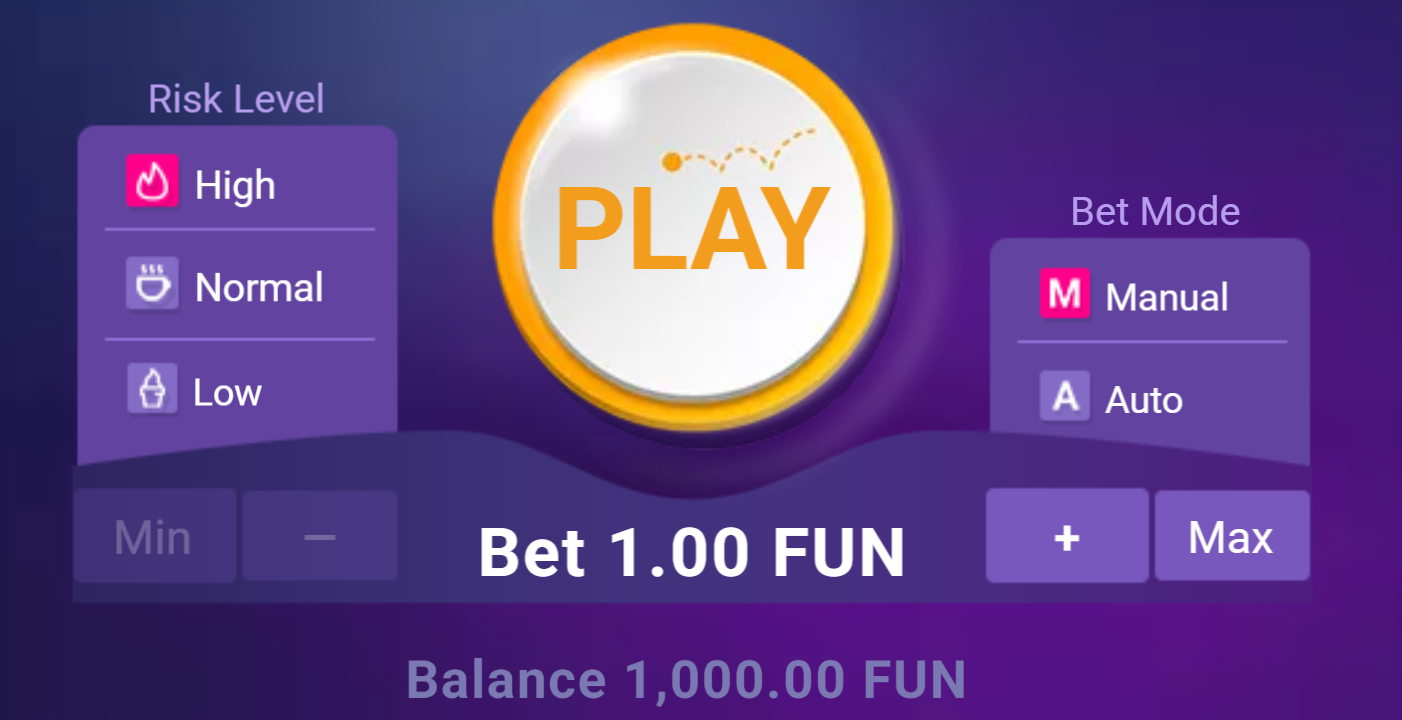
You can identify the BGaming version by its interface: a risk selector offering Low, Normal and High, a rows selector going up to 16, a single stake field, and a Play button with Manual and Auto modes. The multiplier row under the pyramid changes when you change risk or rows, which is itself a useful check. If the game you are looking at has different risk labels, a different maximum row count, or a different top multiplier than the 1000x available at high risk on 16 rows, stop. Find the correct reference material for that version before applying anything here. Our odds and multiplier reference is written specifically for this build.
The Board: Pegs, Rows and Pockets
The board is a triangular grid of pegs. The ball drops from the top centre and, at each peg, deflects left or right. The number of rows you select is the number of peg rows the ball passes through, and it directly determines how many pockets exist at the bottom. At 16 rows, the maximum in this version, there are 17 pockets, and the path the ball takes is effectively a sequence of 16 left-or-right outcomes.
That structure explains the shape of the payout ladder. Centre pockets are easy to reach because many different path combinations land there, so they pay small multipliers, often below your stake. Edge pockets require the ball to deflect the same way almost every time, which is why they pay the headline multipliers. At 16 rows, the probability of hitting one specific outer edge pocket is 1 in 65,536, and the probability of hitting either edge is 1 in 32,768. The centre-to-edge gradient is the entire game: everything else is presentation.
- More rows means more pockets, a wider multiplier spread and a higher top prize.
- Fewer rows compresses the ladder: edges become more reachable but pay less.
- The ball animation is a visualisation of a result the server has already decided; the physics look is theatre, not a mechanism you can influence.
Can you win Plinko by aiming at the centre?
In a physical Plinko board, release position is a real input. In the BGaming demo used here, the controls let you choose the stake, rows and risk; they do not let you drag the ball to a chosen release point. Advice about standing in the centre on television therefore does not describe a control you can use in this game.
The centre also has a different purpose in the payout table. On our 16-row high-risk board it pays 0.2×, so a 10-credit stake returns 2 and loses 8. More centre hits would not mean more profit. Read the actual multipliers before importing a strategy from a television clip, a physics demonstration or another app.
For ‘how to win’ questions, separate a single profitable drop from a profitable complete session. A 2× return doubles the stake returned on that drop; it does not undo all previous losses. The stake and risk examples show the calculation, and the full strategy curves include the losing intervals.
Stakes and controls
Choosing a Risk Level: Low, Normal or High
The risk selector reshapes the multiplier ladder without changing the underlying path probabilities. Low risk flattens the payouts: the centre pockets pay more and the edges pay less, so your balance moves in smaller steps. Normal, labelled as such in the interface, is the middle ladder. High risk does the opposite: the centre pockets pay very little, and the edge pockets pay dramatically more, up to 1000x at 16 rows.
The centre multipliers make the trade concrete. On the standard ladders, the centre pocket pays 0.5x at low risk, 0.3x at normal and 0.2x at high risk. That means the most common single outcome in the game returns less than your stake on every risk level, and the shortfall is largest exactly where the top prizes are largest. High risk is not a better version of low risk; it is a different distribution of the same long-run expectation, with longer losing stretches between rare large hits. Choose the level whose losing stretches you can actually sit through at your chosen stake, and read the full ladder before your first drop rather than after a surprising result.
Setting Your Stake: One Control, One Drop
This Plinko has a single stake field. You type or adjust an amount, and that amount is wagered on the next drop when you press Play. There is no second panel, no dual-bet layout and no cash-out timing decision. If you have seen crash-style games such as Aviator, where two independent bets sit side by side and you decide when to exit, put that model aside. Here the stake is placed once, the drop resolves fully on its own, and the result is credited automatically.
Stake sizing is the one decision you repeat every drop, so it deserves a rule rather than a mood. A fixed stake, such as 1 FUN per drop, makes results easy to compare across a session. A percentage-of-bank approach scales the stake as your balance moves, which changes the arithmetic: at a bank of 1000 FUN, a 1% rule stakes 10 FUN, not 1. Whatever you choose, decide it before the session and write it down, because the fastest way to distort a session is to improvise stake sizes after a few losses. The settings and bankroll controls guide covers sizing frameworks in detail.
Placing Your First Drop and Reading the Result
Once rows, risk and stake are set, press Play. The ball releases, bounces through the pegs and settles into a pocket. The pocket it settles in is the result: the multiplier printed beneath that pocket is applied to your stake, and the return is credited immediately. There is no decision to make after the ball is released, and nothing about the animation path tells you anything about the next drop.
Identify the settled pocket by where the ball stops, not by where it seemed to be heading mid-flight. The game highlights or marks the landing pocket and displays the credited amount, and the result also appears in the round history. When you are learning, check three things after every drop: which pocket it was, what multiplier that pocket pays at your current rows and risk, and what the net change to your balance was. That three-step check takes seconds and builds the habit of reading results as arithmetic rather than as feelings.
Manual Mode, Auto Mode and Overlapping Animations
Manual mode places one drop per button press. You control the pace entirely, which makes it the right mode for learning, for worksheets and for any session where you want to record results. Auto mode places a sequence of drops at your configured stake, and can be combined with stop conditions so the sequence halts when a loss or profit threshold is reached.
The important subtlety is that animations can overlap while settlements do not. In Auto mode, a new ball may release while the previous one is still visually bouncing, especially at faster speeds. Each drop is nonetheless settled individually on the server, in order, with its own stake deducted and its own return credited. The animation is a queue of replays, not a live process. This means two things for a beginner: you cannot influence a drop once placed, and you should read results from the history or balance changes rather than from watching balls. Two balls on screen at once are two already-decided outcomes being shown to you at leisure.
Stop limits deserve the same precision. A stop configured at -20 or +20 checks your settled net after each completed drop and halts the sequence once the threshold is crossed. Because it checks after settlement, a single large result can push you past the threshold before the stop triggers, so the final figure can overshoot the limit you set. Treat stop limits as tripwires, not as exact floors and ceilings.
RTP and payouts
Calculating Stake, Returned Credits and Net: Worked Examples at 2 FUN
The arithmetic of a Plinko result has three parts. Stake is what you paid for the drop. Returned credits are stake multiplied by the pocket multiplier. Net is returned credits minus stake. A result is only a profit when the multiplier is above 1x; at exactly 1x you break even; anything below 1x is a partial return, which feels like a win because credits come back, but is mathematically a loss.

Here are four worked examples at a 2 FUN stake, using multipliers you will actually see on these ladders. At 0.2x, a common high-risk centre result, returned credits are 2 x 0.2 = 0.4 FUN, and net is 0.4 - 2 = -1.6 FUN: you lose most of the stake even though the game credits something back. At 0.5x, the low-risk centre, returned credits are 1.0 FUN and net is -1.0 FUN: half the stake is gone. At 1x, returned credits are 2.0 FUN and net is exactly 0: a true break-even where your balance is unchanged. At 5x, returned credits are 2 x 5 = 10 FUN and net is +8 FUN: a clear profit.
Partial returns matter beyond single drops because they break assumptions in popular staking systems. A classic Martingale assumes a loss means losing the whole stake, so doubling recovers everything after one win. In Plinko, a 0.5x result is a loss of only half the stake, and a 0.2x result is a loss of most of it, so the doubling arithmetic no longer maps onto the outcomes. Any system you test has to be evaluated against net results, not against a binary win-or-lose story. The strategy framework comparisons do exactly that with settled results.
- Net = returned credits - stake. Compute it for every drop, not just the exciting ones.
- Below 1x is a loss, at 1x is break-even, above 1x is profit.
- Partial returns make 2x-recovery systems misprice real outcomes.
Practice and examples
A First-Ten-Drop Practice Worksheet
The best way to learn this game is a structured ten-drop exercise in the free demo mode, where FUN credits let you practise without anything at stake. Set 16 rows, pick one risk level, fix a 1 FUN stake, and play Manual. For each drop, record five things on paper or in a spreadsheet: the drop number, the settled pocket position counted from the centre, the multiplier, the returned credits, and the running net for the session.
After ten drops, answer three questions from your sheet. How many results were below 1x, and what did they cost in total? What was your single best result, and how much of the session’s net did it account for? If you replayed the same ten drops at a different risk level, which numbers on your sheet would change and which would not? That last question is the one that teaches the game: pocket positions are comparable across risk levels, but the multipliers attached to them are not.
Repeat the worksheet once at each risk level and compare the three sheets side by side. Most beginners finish this exercise with a concrete, personal understanding of partial returns that no amount of reading produces, because they have watched their own balance lose money on drops that looked like wins. From there, the drop simulator lets you extend the same recording habit over far larger samples than you would ever click through manually.
- Record: drop number, pocket position, multiplier, returned credits, running net.
- One risk level per sheet; ten drops per sheet; Manual mode only.
- Compare sheets across risk levels to see how the same pockets pay differently.
Where to Go After Your First Session
Once the mechanics are automatic, the interesting questions begin, and they are all testable. Does a capped Martingale survive the partial-return problem better than a classic one? Does a percentage-of-bank rule change the shape of a session compared with a fixed stake? Do stop limits at -20 and +20 actually contain sessions, given the overshoot described above? These are the questions this site’s research programme was built around, and the recorded session results show how each framework behaved over measured samples rather than over anecdotes.
A sensible path is: master the controls here, run the ten-drop worksheet in the demo, read the odds reference so the ladders are familiar, and only then start comparing staking systems. Plinko will not reward any of this with guaranteed profit, and no setting changes the long-run expectation of the game. What deliberate practice does change is whether you understand exactly what happened to your balance after every drop, which is the difference between studying the game and merely watching it. The research home page maps the full set of topics if you want the complete picture.

Mobile play
Playing on Mobile: Controls and Layout
The game runs in the browser on phones and tablets with the same rules and the same ladders; only the layout adapts. The stake field, risk selector and rows selector collapse into a control panel, usually below the board or behind a toggle, and the Play button becomes a large tap target. We have not tested specific devices, so treat the following as orientation rather than a device report.
Two practical habits matter more on a small screen. First, verify your stake and risk after every settings change, because compact panels make it easier to tap past the option you meant to select, and a wrong risk level changes every payout on the board. Second, prefer Manual mode while learning on mobile, because Auto sequences plus small screens make it harder to track individual settled results, and the overlapping animations described above are even easier to misread on a phone. If you use Auto, set the stop conditions before starting and read the history afterwards rather than trying to follow the balls.
A Note for Readers in France
France’s regulator, the ANJ, states that online casino games are not authorised in France, and that a French-language interface or a euro account does not make an offer authorised. This site is a free learning and mathematics project built around FUN-credit demo play and provider observations; it does not offer or point to a legal French cash game, and nothing here is a route around local rules. Treat the guide as study material for understanding how the game works.
Within that frame, the French-language questions that bring readers here are good research leads: how to win without confusing simulation with prediction, whether a martingale found in past history works afterwards, and whether free mode and money mode share the same conditions. The honest answers are structural. Simulation reveals distributions, it does not predict the next drop. A pattern fitted to past results needs testing on fresh data before it means anything. And demo play is the right environment for exactly this kind of learning, which is why every worked example on this site is recorded in FUN.
Plinko questions answered
What is the minimum I need to decide before a Plinko drop?
Three things: the number of rows (up to 16 in BGaming Original Plinko), the risk level (Low, Normal or High), and your stake in FUN. After that, pressing Play commits the drop and the result settles automatically.
Why did I get credits back but still lose money?
Many pockets pay below 1x. At a 2 FUN stake, a 0.5x pocket returns 1 FUN, which is a net loss of 1 FUN. Any multiplier below 1x is a partial return and mathematically a loss, even though the game credits something.
Is Auto mode rigged differently from Manual mode?
No. Both modes place individual drops that settle on the server in order. Auto simply places them in sequence without your input. Overlapping ball animations are replays of already-settled results, not a different mechanism.
Does the ball’s path tell me anything about the next drop?
No. Each drop is an independent settlement, and the animation is a visualisation of a result already decided. A ball that nearly reached an edge pocket was never close in any meaningful sense; the outcome was fixed before the animation played.
Can I use a payout table from another Plinko game?
No. Row counts, risk labels and multiplier ladders differ between providers and versions. Confirm you are playing BGaming Original Plinko, with Low, Normal and High risk and up to 16 rows, before applying any table from this site.
Is there a strategy that wins every time?
No. No staking system changes the game’s long-run expectation, and systems like Martingale misprice Plinko’s partial returns. What you can control is stake sizing, risk selection, stop conditions and how carefully you record and understand your results.