Rows and risk
What Plinko Settings Actually Control
BGaming Original Plinko offers two structural levers: the number of rows, adjustable from 8 to 16, and the risk level, labelled Low, Normal and High in the interface. Everything else on the screen, including the stake field and the autoplay counter, is an input to your session rather than a property of the game itself. Understanding this split matters because many players treat the settings panel as a single block and change several things at once, which makes any later observation impossible to interpret.
The most important structural fact is that a fixed row count fixes the landing probabilities. With 16 rows, the ball makes 16 binary bounces, so the probability of landing in a given pocket is determined by binomial mathematics and does not move when you switch risk. What the risk selector changes is the payout strip: the multipliers printed under each pocket. Switching from Low to High at 16 rows does not make the edges more likely; it makes the edges pay far more and the centre pay far less. The centre multiplier on Normal is 0.3, on Low it is 0.5, and on High it drops to 0.2, while the High edge multiplier reaches 1000. Same ball, same probabilities, different paytable.
This is why the phrase best settings is misleading without a goal attached. There is no configuration that shifts the odds in your favour. There are only configurations that reshape the distribution of outcomes: how often a drop returns something close to the stake, how deep the typical losing runs go, and how much of the total return is concentrated in rare edge hits. Choosing settings is choosing the shape of variance, not the direction of expectation.
- Rows (8–16): change both the number of pockets and the landing probabilities.
- Risk (Low/Normal/High): changes only the multipliers on the payout strip at a fixed row count.
- Stake and autoplay: session inputs, not game properties; they scale outcomes but never alter the strip.
Row Count: What Changes Between 8 and 16 Rows
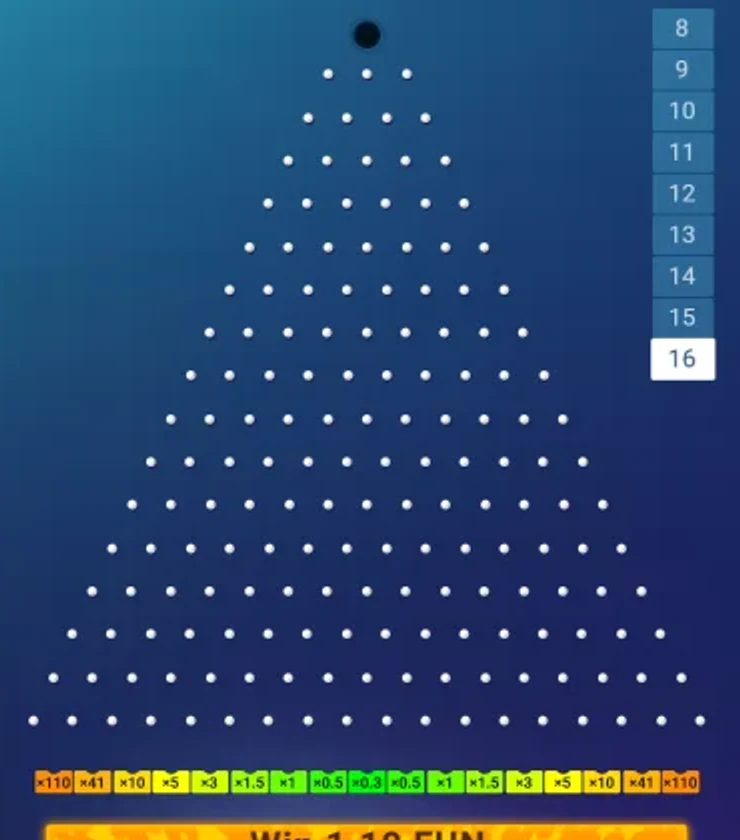
Adding rows widens the board and the payout strip. At 8 rows there are 9 pockets; at 16 rows there are 17. The centre pockets remain the most likely landing zones in every configuration, and the outer edges remain the rarest. What changes with more rows is how extreme the extremes become. The probability of hitting either outer edge is 1 in 128 at 8 rows, 1 in 2048 at 12 rows, and 1 in 32768 at 16 rows, with a single specific edge at 16 rows sitting at 1 in 65536.
The practical consequence is that row count is your main dial for rare-payout exposure. If you want the 1000x edge multiplier on High risk to be a realistic event within a session, 16 rows makes it a once-in-tens-of-thousands event, while 8 rows makes it merely unlikely. Neither is a promise; the waiting-time formula 1-(1-p)^N tells you the probability of at least one edge hit in N drops, and even 500 drops at 16 rows leaves the chance of seeing a specific edge below one percent.
More rows also compress the centre. Because the strip spreads across more pockets, the central multipliers at 16 rows tend to cluster tightly around small fractions of the stake, which means the typical drop returns a partial payout. Fewer rows produce a coarser strip where mid-range pockets carry more distinct values. Players who want frequent, readable outcomes often find 8 to 12 rows easier to evaluate, while players studying tail behaviour gravitate to 16 rows because that is where the published extremes live. You can explore both in the Plinko simulator before committing to a testing plan.
Low, Normal and High Risk Compared
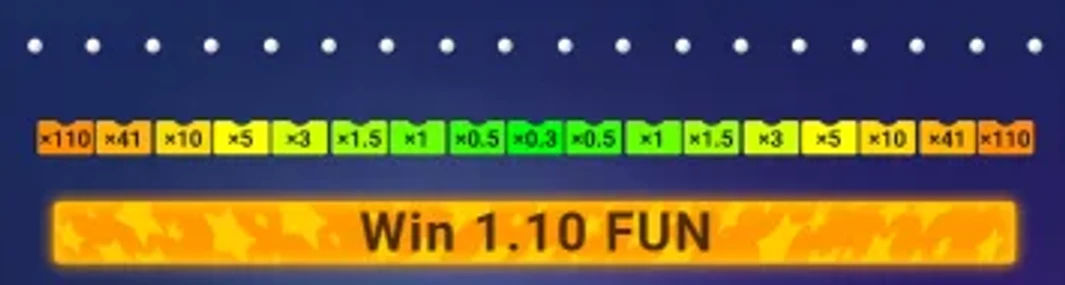
Risk level is a paytable choice. Low risk flattens the strip: the centre pays 0.5 of the stake at the worst central pocket, mid pockets hover near or above the stake, and the edges are modest. High risk hollows the centre out to 0.2 and concentrates value at the extremes, with the 1000x edge multiplier as the headline. Normal sits between, with a 0.3 centre. In all three modes, most drops land near the middle, so the centre multiplier is the number you will experience most often.
This creates a counterintuitive feel. Low risk produces many drops that return roughly half the stake, which looks like steady play but is actually a slow bleed of partial losses. High risk produces long stretches of 0.2 returns punctuated by occasional large hits, which feels like losing constantly even when the session is behaving exactly as designed. Normal splits the difference. None of the three is mathematically kinder; they distribute the same underlying disadvantage differently across time.
A useful way to frame the choice is to ask which failure mode you tolerate better. Low risk fails slowly and visibly through accumulation of small shortfalls. High risk fails in drawdowns that can erase a large fraction of a session bank before any edge hit arrives. Normal fails somewhere in between. Picking a risk level is therefore a decision about drawdown shape, and it should be written down before a test, not negotiated during one. The Plinko odds breakdown shows the full strip for each mode so you can compare the exact multipliers rather than relying on feel.
- Low: centre 0.5, shallow edges, frequent small partial returns.
- Normal: centre 0.3, moderate edges, balanced distribution.
- High: centre 0.2, edge up to 1000x, long quiet stretches between large hits.
Stakes and controls
Input Order: Set Structure Before Stake
The order in which you configure a session determines whether your results mean anything. The correct sequence is: choose rows first, then risk, then stake, then any progression or stop rules, and only then start dropping. Rows and risk define the game you are playing; stake and progression define how you are betting on it. Mixing the order, for example raising the stake and switching risk in the same session, makes it impossible to attribute a change in results to either decision.
A concrete example of the wrong order: a player runs 200 drops at 16 rows on Normal with a 1 FUN stake, hits a drawdown, switches to High risk and doubles the stake at the same time, then recovers. Which change caused the recovery? Nothing can be concluded, because two variables moved together and the sample is small. The same recovery could have occurred with either change alone or with no change at all. This is the single most common analytical error in self-run Plinko tests.
The discipline is simple to state and hard to keep: one change at a time, with a recorded baseline. Run your reference configuration for a fixed number of drops, note the net, the maximum drawdown and the count of profit versus loss drops, then change exactly one setting and repeat. Our own testing protocol uses 1000 paid drops per risk level at a fixed 1 FUN stake with 16 rows, precisely so that risk is the only moving part. You do not need the same sample size, but you do need the same isolation.
- Step 1: fix rows. Step 2: fix risk. Step 3: fix stake. Step 4: define stop rules.
- Record baseline results before changing anything.
- Change exactly one variable per test block; never two at once.
Desktop and Mobile Control Walkthrough
On desktop, the control panel sits to the left of the board. The rows selector is typically a dropdown or stepper showing values from 8 to 16; changing it rebuilds the board immediately, so confirm the row count visually by counting the peg lines before your first drop. Below it, the risk selector offers Low, Normal and High; the payout strip under the board updates the moment you switch, which is the fastest way to verify the change took effect. The stake field accepts manual entry, and the bet button drops a single ball. Autoplay, where enabled, lets you queue a fixed number of drops at the current settings; set the count before pressing it, because queued drops inherit whatever is configured at the moment they fire.
On mobile, the same controls collapse into a compact panel, usually behind a menu icon or below the board in portrait orientation. The two mobile-specific risks are accidental input and misread state. A thumb tap on the stake stepper can double a stake without obvious feedback, and the payout strip may require scrolling to see the edge multipliers, so players sometimes switch risk without ever seeing the new strip. The habit to build is a three-point check before every session block: read the row count off the board, read the risk label, and read the stake field, in that order.

Both versions settle each drop before the next input is accepted in manual mode, which matters for stop rules. If you use stop limits, they are checked against settled net results, and a single large payout or a queued autoplay batch can overshoot a threshold before the check fires. In the stop-limit presets we evaluated, the limits check the settled net against -20 and +20 after settlement and can overshoot, so the limit is a review trigger, not a hard wall. These presets are separate from the fixed-stake recording protocol. Treat stop limits the same way in your own sessions, and verify behaviour in the free Plinko demo rather than assuming it.
Bankroll and limits
Reading the Payout Strip and Partial Returns
The payout strip is the row of multipliers beneath the pockets, and it deserves more attention than the ball animation. Each number is a multiplier applied to your stake. A 1 FUN stake landing on 0.5 returns 0.5 FUN, which is a loss of half the stake even though the game credits a payout. This is the partial return problem: every pocket in this recorded table pays something, but a credited return is not necessarily a net win. At 16 rows, losses account for about 19.64% of theoretical landings on Low, 54.55% on Normal and 78.99% on High.
Partial returns break several popular staking ideas. A classic Martingale assumes a loss returns nothing and a win doubles the stake, so doubling after a loss recovers everything. In Plinko, a losing drop usually returns 0.2 to 0.5 of the stake, which means the next doubled bet must recover the shortfall plus the new stake, and a 2x recovery assumption is simply invalid. Any progression system imported from roulette-style even-money games needs to be re-derived against the actual strip, and most are not.
The correct habit is to classify every settled drop as profit (payout above stake), break-even, or loss (payout below stake), and to track the net rather than counting credited payouts as wins. In our rule semantics, a loss means the payout is below the stake and a profit means it is above; break-even holds any progression in place. When you read a session history through that lens, the strip stops looking generous and starts looking like what it is: a distribution where the centre subsidises the edges.
Choosing a Measurable Goal
A measurable goal is a statement you can check against a session log, not a feeling. The three most useful goal types map directly onto the settings. Frequent positive drops means maximising the count of drops returning above the stake, which pushes you toward Low risk and fewer rows, where more pockets pay at or above 1x. Lower drawdown means minimising the worst peak-to-trough decline of the bank, which also favours Low risk but additionally favours flat staking, because any progression amplifies losing runs. Rare payout exposure means maximising the chance of a large multiplier within a planned number of drops, which points to High risk and a row count chosen with the waiting-time formula rather than automatically set to 16.
Each goal has an honest trade-off. Frequent positive drops come with a centre multiplier of 0.5 on the misses, so the bank still erodes between positives. Lower drawdown caps both losses and the size of any recovery. Rare payout exposure accepts that most sessions will contain no large hit at all: at 16 rows, even the combined either-edge probability of 1 in 32768 means a 1000-drop session will usually see none. Writing the goal down with its trade-off, for example I accept a centre return of 0.2 in exchange for edge exposure at 12 rows, turns settings selection into a decision instead of a superstition.
What no goal can do is change the expectation. Every configuration of rows and risk in this game carries a built-in house margin, and no arrangement of 8 to 16 rows and three risk modes produces a configuration that guarantees money. The settings let you choose the texture of the experience and the variance you are exposed to; they do not let you choose to win. Any guide, pattern or progression that claims otherwise is confusing simulation with prediction, which is exactly the confusion the French-language research questions behind this project warn about.

Worked Configuration Examples
Example one, the frequent-positive-drops goal. Configure 10 rows, Low risk, 1 FUN flat stake, 200 drops. On this strip, several central and mid pockets pay at or above the stake, so the count of profitable drops is high relative to other configurations. The cost is that the misses return around half the stake and the edge multipliers stay modest compared with Normal or High, so the session net will drift downward slowly. The measurable success criterion is not profit; it is whether the proportion of positive drops matches what the strip predicts, which you can compute by summing the probabilities of all pockets paying above 1x.
Example two, the rare-payout-exposure goal with honest arithmetic. Suppose you want a realistic chance of an edge hit within an evening of 400 drops. At 16 rows, the either-edge probability is 1 in 32768, so 1-(1-1/32768)^400 is about 1.2 percent: you will almost certainly not see one. At 8 rows, the same formula with 1 in 128 gives roughly 95.6 percent across 400 drops. If the goal is to experience an edge hit, 8 rows on High serves it; 16 rows serves the goal of chasing the largest published multiplier, which is a different goal with a much longer waiting time. Choosing between them is a settings decision, and it should be made with this arithmetic, not with the size of the number on the strip.
Example three, the drawdown goal with a hypothetical EUR illustration. Imagine a casual player budgeting a hypothetical 20 EUR equivalent of entertainment value for a session and wanting the worst moment to feel acceptable. Take a hypothetical stretch of 30 drops that each return the centre multiplier. On High risk at 16 rows, at a centre return of 0.2, such a stretch converts 30 staked units into about 6 returned. On Low risk, with a centre return of 0.5, the same stretch returns about 15. The drawdown shapes differ by a factor of more than two before any edge hit is considered, which is why the drawdown goal almost always selects Low risk and flat stakes. These figures are illustrative arithmetic only; recorded session credits in the game itself remain in FUN.
How Staking Systems Interact With Settings
Staking systems sit on top of the settings and inherit their problems. Martingale doubles after a loss and resets after a profitable result, but Plinko partial payouts invalidate the 2x recovery assumption, so the progression grows stakes to chase shortfalls it cannot reliably recover. With the tested capped Martingale, the five stake levels are 1, 2, 4, 8 and 16 FUN. A fifth consecutive net loss resets the next stake to 1. Those five bets expose 31 FUN before returns; this limits one progression, not the accumulated loss over repeated progressions. Percentage staking starts at 1 percent of the current bank, so at a bank of 1000 it stakes 10, not 1, and the stake shrinks after losses and grows after wins, which smooths but does not reverse the expectation.
D’Alembert adds one unit after a loss and subtracts one after a profit, with a floor at the base stake. Fibonacci advances one step after a loss and moves two steps back after a profit. Paroli doubles after wins and resets after three winning steps or any loss. 1-3-2-6 progresses through its sequence after wins and resets after a loss. Each of these was designed for even-money games where a loss returns zero. On a strip where the most common outcome returns 0.2 to 0.5 of the stake, their step logic still functions mechanically, but the recovery mathematics they were built on does not apply. The risk level you chose underneath determines how severe the partial-return drag is between progression steps.
The interaction worth remembering is between progression and risk mode. A progression on High risk escalates stakes into a strip where the typical return is 0.2, which compounds drawdown fastest. The same progression on Low risk escalates into 0.5 returns, which is gentler but still negative in expectation. If you test any progression, test it at a fixed row count and fixed risk with a recorded baseline of flat staking at the same settings, and compare maximum drawdown and settled net, not the number of credited payouts. Our strategy test results module reports exactly these comparisons on fresh FUN samples as they are completed.

How can you avoid overspending while testing Plinko strategies?
Set the total amount you can afford to lose before the session, including every possible restart. In a hypothetical 100-credit budget, five separate 20-credit allowances still expose 100 credits. Resetting the session counter after each loss does not restore the money. Keep one cumulative balance alongside the session balance.
For a clearer demo comparison, use a fixed stake, place one drop at a time and stop at the first of your time, drop-count or loss limits. Wait for all accepted drops to settle. A stop-loss checked after a result may overshoot its threshold; it cannot cancel stakes already accepted. The simulator’s stop controls apply to the model, not to an external casino account.
A 1% stake from a 1,000-credit starting bank is 10 credits. A lower percentage reduces the amount exposed per drop; it does not improve the probability of the next pocket. Use the bankroll simulator to compare drawdown and completed bets before choosing a practice configuration.
Compare and test
Frozen Patterns, Version Drift and Table Reuse
A recurring temptation is to read the recent pocket history as a signal. The pattern hypotheses in this project are deliberately precise so they can be tested rather than vibes. Pattern A100 triggers when the previous five pocket distances run 1–2, then 3 or more, then 1–2, then 1–2, then 3 or more. It places one 100 FUN stake followed by eight ordinary 1 FUN paid drops. B50 and B100 trigger when the previous three distances are 4 or more, then exactly 1, then exactly 1, staking 50 or 100 FUN followed by three ordinary drops. C25 triggers when the previous 16 pockets contain at most one exact centre, staking 25 FUN followed by three ordinary drops. These are hypotheses frozen in advance so they can be checked on fresh data, not observed regularities, because each drop is independent and a frozen pattern has no predictive mechanism.
The other quiet threat to good testing is version and table reuse. An incorrect version of a payout table, copied from a different row count or a different provider’s Plinko, will produce wrong expectations even if your arithmetic is perfect. Before any calculation, verify that the strip you are reading matches the board in front of you: count the pockets, check the centre multiplier for your risk mode, and check the edge value. A 16-row High strip and a 12-row Normal strip are different tables with different pocket counts, and reusing one for the other invalidates every derived number, including waiting-time estimates and progression recovery targets.
The same caution applies to reusing results across settings. A drawdown measured at Low risk tells you nothing about Normal, and a hit frequency measured at 8 rows cannot be extrapolated to 16 rows, because the probabilities themselves changed. Keep each test block labelled with its exact configuration, and treat any table, screenshot or forum claim that does not state rows and risk as unusable. Numeric results from our own samples are published only in the rendered evidence module; this article deliberately contains no observed counts, because none should be invented and none should be borrowed from unverified sources.
A One-Change-at-a-Time Testing Protocol
A serviceable home protocol needs five elements: a fixed configuration, a fixed sample, a recorded baseline, a single changed variable, and pre-registered success criteria. Fixed configuration means rows, risk and stake written down before the first drop. Fixed sample means a drop count decided in advance, because stopping early when ahead and continuing when behind manufactures whatever result you wanted. Recorded baseline means a full block at the reference settings before any change. Single changed variable means exactly one of rows, risk, stake or progression differs in the next block. Pre-registered criteria mean you write down what would count as the change mattering, such as maximum drawdown lower by a stated margin, before you see the data.
An example block pair. Baseline: 12 rows, Normal risk, 1 FUN flat stake, 300 drops, recording settled net, maximum drawdown, and counts of profit, break-even and loss drops. Test block: identical except risk moves to High. After both blocks, compare the three metrics. If drawdown roughly doubles and the loss-drop count rises while the settled net stays within noise of the baseline trend, you have learned what High risk does to your session shape, which is a real, transferable finding. If you had also changed the stake, you would have learned nothing.
Two failure modes deserve naming. The first is the stop-limit illusion: stop rules checked against settled net at -20 and +20 can be overshot by a single large payout or a queued batch. Restarting after a stop resets only the cycle reference while keeping the remaining bank and all subsequent paid drops. So a restart does not erase history and must not be treated as a fresh experiment. The second is sample-size amnesia: 100 drops at 16 rows will usually contain no edge hit at any risk level, so a block that small can only characterise the centre of the distribution. Match the sample to the question, and use the waiting-time formula to check that the question is answerable at all.
- Write the configuration and sample size down before the first drop.
- Run the baseline block first; change one variable; rerun.
- Compare settled net, maximum drawdown and profit/loss drop counts, never credited-payout counts.
- Treat restarts as continuations of the same bank, not new experiments.
A Note for Readers in France
The French regulator, the ANJ, states that online casino games are not authorised in France, and that a French-language interface or a euro-denominated account does not make an offer authorised. This project is therefore framed around free learning, probability mathematics and provider-demo observation in FUN credits, with no claim that any linked option is a legal French cash game. No method in this guide, and no setting, changes the legal status of an offer or the mathematical expectation of the game.
Within that frame, the guide remains fully usable: the demo costs nothing, the arithmetic is identical, and the testing protocol builds skills in probability literacy that transfer anywhere. The French-language questions that motivated this project, such as how to avoid confusing simulation with prediction and whether a pattern found in history works afterwards, are answered by the method itself. Freeze hypotheses in advance, test on fresh data, and never treat a replayed past as a forecast.
Putting It Together: A Settings Checklist
The shortest honest summary of this guide is a checklist. Decide your goal first: frequent positive drops, lower drawdown, or rare payout exposure. Translate the goal into rows and risk using the strip and the waiting-time arithmetic, not the size of the headline multiplier. Set the stake flat and small enough that the planned sample cannot exhaust the session bank. Write the configuration down. Run the baseline. Change one thing. Compare settled net, drawdown and drop classification. Ignore credited-payout counts, pocket-history hunches and any table that does not state its rows and risk.
If you follow that process, the question of best settings answers itself in a narrower and more useful form: the best settings are the ones whose trade-offs you chose deliberately and can verify in your own log. Everything else, from 1000x edges to frozen pocket patterns, is variance wearing a costume. Start with the project home to see how the settings, odds, simulator and results modules fit together, and treat every session as data rather than destiny.
Do the best Plinko settings on Stake or 1xBet apply here?
An operator name is not a payout table. Stake Originals Plinko and BGaming Original Plinko are different products. A search for ‘how to win Plinko in 1xBet’ also does not identify which provider, table or build is being played. Our 3,000-drop sample does not test either operator’s cash account or every game in its lobby.
Before comparing settings, match the provider, row count, risk level and every pocket multiplier. At 16 rows, the BGaming high-risk table used here pays 0.2× in the centre. A 5-credit drop there returns 1 credit and loses 4. If another board has a different centre return, the same loss progression produces different balances. Use the BGaming practice demo to identify this version; do not label these results as a tested Stake or 1xBet strategy.
Reddit strategies
Best Plinko strategy on Reddit: which claims are worth testing?
The discussions we read contain competing suggestions, not an agreed winning system. One r/stakeus post raises the stake after roughly 25 returns of 0.2× in 30 drops. Other comments favour bursts of 5–8 balls, seed changes or particular times of the hour. These are player reports. A memorable winning session does not establish which part of the routine caused the result.
Separate the proposal into a trigger, stake, reset and stopping rule. “Raise after many low returns” is too vague to reproduce. Write down exactly how many previous drops count and when the higher stake ends. Then compare every completed bet with a fixed-stake replay on the same sequence. Our historical results and strategy curves provide that comparison for the rules we actually tested; they are not a test of every Reddit claim.
The thread claiming a million Plinko drops is also a useful reminder to inspect the evidence behind a large sample count. Replies question its reporting. We have not independently verified that experiment and do not use its casino ranking as a measured result. A useful comparison needs identifiable game versions, full ordered results, stakes and a reproducible calculation—not just a headline sample size.
For the concrete calculations, see tap bursts, stake increases and seed claims. For physical-board advice about aiming at the centre, use the version and controls guide. A release position on a television board is not a steering control in this browser demo.
Do bursts of 5–8 Plinko balls change the result?
A comment in the Plinko strategy discussion proposes 16 rows, high risk and short bursts at 0.44 or 0.88 per ball. It also changes seeds and switches games. That bundles several decisions together, so a reported win cannot tell us whether the tapping rhythm helped.
The immediate calculation is exposure: five accepted bets at 0.44 commit 2.20 credits; eight at 0.88 commit 7.04. Those stakes remain at risk while the balls settle. A pause can help you see the balance and avoid sending another batch accidentally. It is not evidence that the next pocket becomes more favourable.
Replaying an unchanged result sequence with the same stakes gives the same net total whether you display it in groups of five or eight. That is an accounting fact, not a live experiment on the provider’s timing. To compare pacing itself, you would need a separate recorded test, a fixed protocol and all accepted bets. Our current corpus does not establish a timing advantage.
Raise the stake after 25 low returns: what is the actual rule?
One player describes increasing from 0.25 to 0.50 after about 25 results of 0.2× in about 30 drops. Later stake changes and resets are described less precisely. We have not reproduced that player’s account or verified the reported profit. A repeatable adaptation would have to specify an exact lookback, threshold, higher stake and reset before testing.
At 0.2×, a 0.25-credit stake returns 0.05 and loses 0.20. A 0.50-credit stake returns 0.10 and loses 0.40. The increase doubles both the possible payout and the amount lost on that outcome. It does not itself change the next pocket’s probability. In an independent-drop model, a run of low returns does not make a higher return due.
A useful test keeps the fixed-stake comparison, every losing interval and any bankroll stop. Our tested historical strategies include positive examples with their complete drawdowns. A profit found after inspecting a sequence is a reason to test the frozen settings on new data, not a verified forecast.
Do seed changes every 500 drops or end-of-hour bets help?
The 1,000× discussion includes suggestions to change seeds within 500 drops and play near the end of an hour. Other replies describe different routines and losses. These reports do not isolate a repeatable advantage.
In the published Stake fairness implementation, the random calculation uses server and client seeds plus a nonce and cursor. A seed change changes the sequence; it does not reveal which new sequence will be profitable. Wall-clock minute is not an input in that documented calculation. This statement concerns that implementation, not every product named Plinko.
Our BGaming sample is not a controlled trial of seed rotation or hour-of-day effects. We therefore do not label either routine as tested. For a repeatable comparison, change the stake rule while keeping the recorded results fixed; use a fresh recorded sample to evaluate a rule chosen in advance.
Plinko questions answered
What are the best Plinko settings for beginners?
For learning, 10 to 12 rows on Low risk with a flat 1 FUN stake is the most readable configuration: the strip is easy to verify, partial returns are gentle, and drawdowns are shallow. It does not win more; it makes the mechanics visible.
Does changing risk change where the ball lands?
No. At a fixed row count the landing probabilities are fixed by the binomial structure of the board. Risk only changes the multipliers on the payout strip: Low pays more in the centre, High pays more at the edges.
Is 16 rows better than 8 rows?
Neither is better; they serve different goals. Sixteen rows offers the largest multipliers but makes any edge hit a 1-in-32768 event per drop. Eight rows makes edge hits roughly 256 times more likely per drop, though the edge multipliers printed on an 8-row strip are a different paytable from the 16-row values and must be read off the board rather than assumed.
Why does my balance fall even though the game keeps paying out?
Most Plinko payouts are partial returns below the stake, such as 0.2 to 0.5 of the bet. The game credits them as payouts, but each one is a net loss. Track settled net per drop rather than counting credited payouts.
Does Martingale work on Plinko?
Classic Martingale assumes a loss returns zero and a win doubles the stake. Plinko losses usually return part of the stake, so the 2x recovery assumption is invalid and the progression escalates stakes without reliably recovering shortfalls.
Can I test settings properly in the free demo?
Yes. The FUN demo uses the same board mathematics, so it is the right environment for one-change-at-a-time testing with a recorded baseline, a fixed sample size and pre-registered success criteria.